Cards and chip accounting
Check hand rankings, legal replacements, action order, caps, all-ins and conservation of chips. Test A-5 and 2-7 ace handling separately.
 Mixed Game Pro
Behind the decisions
Choose a game, follow an action line and compare the value of your options. Here is how we turn cards and betting decisions into a strategy you can study and practice.
From cards to strategy
The four tools share betting and training infrastructure. Each game has its own hand evaluator, draw rules and range model.
Game, position, pot, stacks and the actions already taken.
Weight the hands reaching this line and model legal replacements.
CFR+ trains a strategy in the supported abstract betting tree.
Display action frequencies and EV; use the shared model in training.
Live tools solve betting stages using modeled draw continuation values. The complete hand is not yet trained as one joint equilibrium.
Reading your result
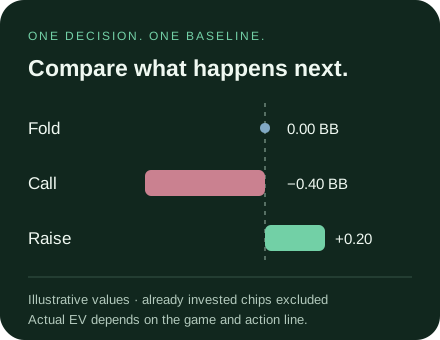
Every action at a decision uses the same starting point. Chips you have already invested are sunk costs, so Fold is 0 BB.
If Call is −0.40 BB and Fold is 0 BB, folding is better. If another action has a higher EV, compare that too. These are illustrative numbers, not a recommended poker line.
Draws change the decision
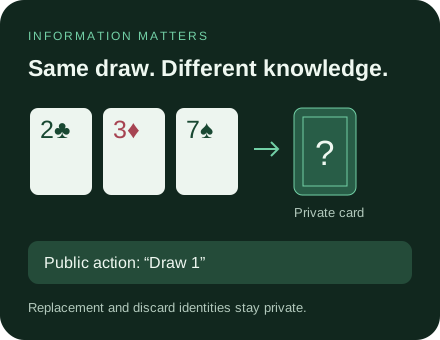
The cards kept, draw potential, position, betting history and opponent’s public draw count all matter. A hand can change its draw choice along a different action line.
High-card grouping is a way to browse the table. It does not mean every hand in that group should always Pat, Draw 1 or Draw 2.
Our offline research engine’s information sets remember a player’s own cards and actions, while keeping the opponent’s private cards hidden. The live engine compresses some card and draw information into buckets.
How we check our work
These checks answer different questions. Passing a card or betting test does not establish an optimal full-game strategy.
Check hand rankings, legal replacements, action order, caps, all-ins and conservation of chips. Test A-5 and 2-7 ace handling separately.
Compare values and best responses with separately enumerated small games. Also test whether an opponent using exact hand information can exploit the grouped strategy.
Compare independent training runs and budgets. Test fresh hands, count decisions without training updates, and measure best-response gaps in the reference games.
Check matching legal actions, decision EVs and model versions. Keep unvalidated research policies out of live trainer scores.
Model coverage · updated 11 September 2026
Single Draw trains pre-draw and post-draw betting separately. Triple Draw trains path-conditioned betting rounds. Draw choices and continuation values are partly sampled or heuristic.
The near-zero pre-draw Fold range in A-5 and 2-7 Triple Draw remains a known opening-model limitation. Cheap completions can look too valuable when later betting costs are omitted. It does not establish that every hand should be played.
Current results describe a heads-up abstraction. They are not a certified full-card GTO solution.
The replacement framework deals from the full deck and follows replacement cards and betting through the remaining hand. It shares learning between similar hands while remembering earlier observations and actions.
Small reference games pass independent EV and best-response checks. Larger runs still encounter insufficiently trained decisions and unstable opening strategies, so the replacement is not ready for live use.
Research results are isolated from live recommendations and saved practice scores.
We will not add an arbitrary folding percentage to make a chart look plausible. Opening ranges must follow from the game and validated continuation values.
Choose your game
A closer look
No. Each current tool solves an abstracted version of its game. Cards are grouped into strategic classes or strength buckets, and future draws use deterministic samples or continuation estimates. Convergence is not guaranteed by running the tool: check the best-response gap within the abstraction. This does not establish full-card game accuracy.
It depends on the game. In 2-7 Single Draw, CFR+ trains pre-draw betting using sampled one-draw terminal equity, then trains post-draw betting separately. Draw declarations remain modeled. In 2-7 Triple Draw, each betting round uses path-conditioned CFR+. After Draw 2, its betting values look through sampled final draws; on Draw 3, made hands compare Pat equity with replacement-card equity before the final betting solve. Earlier draw choices and snowing remain modeled outside CFR+.
Frequency is the current model’s action mix, not a legality rule. Frequencies below 0.01% display as 0%. The action path hides betting options below that threshold; the engine and detailed analysis retain the full action set. Draw counts remain available to explore. A truly zero-probability action has no uniquely defined conditional range. For a forced draw, the tool retains the preceding range as an exploration assumption and shows zero path reach.
EV starts at the current decision. Chips already invested are sunk costs, so folding has zero additional cost. Every action uses the same reference: an old hand-relative Fold EV of -0.50 BB and Limp EV of -0.41 BB become 0.00 BB and +0.09 BB. Action rankings and EV gaps stay the same. If continuing instead has negative EV from this decision, folding is better. Changing this reference does not validate the opening model’s future-betting assumptions.
No. The current 2-7 and A-5 heads-up opening models value a called betting round using the next draw’s equity. They do not include later betting costs, position-dependent equity realization or jointly optimized snowing in the opening decision. This can make a 0.5 BB small-blind completion look preferable to folding even very weak hands. That result is not a validated full-game opening recommendation. Published starting-hand guidance also depends on whether the game is heads-up, has more players, and allows limping; a raise-or-fold chart is not directly comparable. Badugi uses a different hand model and currently does retain a folding range. A reliable correction requires future betting and draw continuation values, rather than adding a minimum folding percentage.
The three fixed-limit solvers use a standard 40 BB heads-up setup. Their current opening model stops at next-draw equity, and the first round's five-bet cap fits within 10, 20 and 40 BB. That makes the modeled opening ranges identical, so the solver does not offer a stack selector. Chip EV is not generally stack-independent: future betting costs and all-in boundaries matter in a full game. Practice hands still support stack selection to exercise those all-in boundaries, using the same engine as the solver.
Deeper stacks allow larger re-raises and different continuations; opening ranges do not have to widen as stacks increase. The no-limit presets use the same starting-hand abstraction and draw-equity inputs, but train separate betting trees for each stack. The current 40 BB model folds more than its 10 and 20 BB counterparts. This is an outcome of that abstract pre-draw game, whose called pots terminate on sampled draw equity. Post-draw betting is solved separately, so these exact opening frequencies are not a validated full-game benchmark.
Yes when comparing the same abstract betting tree, ranges, bucket count, and sizing configuration. The value measures improvement available to exact best responses inside that supported betting tree; it is not a whole-game guarantee for the modeled pre-draw and draw layers.
No. High Precision is planned to use 40 or more hand buckets together with additional CFR+ iterations. That can reduce abstraction error and expose finer strategic differences, but it cannot guarantee a more accurate full-game solution. A larger model also needs enough training; otherwise rare nodes may converge more slowly or look noisier.
Not fully. The models preserve useful hand structure, discarded cards, draw potential, and selected blocker effects. The Triple Draw final-street matrix compares sampled exact hands and removes overlapping cards, but earlier streets and unsampled combinations remain compressed abstractions.
The shared principles will: legal game trees, range filtering, hand abstraction, deterministic results, and clear limitations. Each new mixed game will still need its own evaluator, betting structure, draw policy, and validation before release.
Research foundation